Last weekend I was at a dance weekend in a lodge on Mt. Baldy. I had cause to pause and reflect on why in the world am I playing cello, and what am I trying to accomplish, and while I’m at it, what is it I appreciate about music, and admire about musicians, anyway?
Naturally, we had a live band, in this case - Bandáge à Trois, from Utah. I figure, from Friday evening to Sunday evening, they were on for at least 15 hours. When they were on, they played about 85% of the time. The remaining 15% was time when the “caller” (in olden days would be called the Dancing Master) was teaching the dance. While I was not present for all 15 hours, I was for most of it, and I never heard a tune repeated for more than one dance, and many of those tunes were quite distinctive; I would have recognized them. Tunes from all over Europe, in this case, French and Scandinavian tunes were particularly well-represented. Bourrees, branles, waltzes, jigs, reels, polkas, hambos,…. And for each tune within the dance, there was plenty of variation across repeats. A grueling test of endurance. I’m so impressed at their preparation, stamina, teamwork between musicians, teamwork with the caller, excellent tune choices for individual dances, stimulation to the dancers, and musical imagination. I’m still in awe.
That band and caller carries on a special and very challenging tradition that well predates J S Bach. I believe the adjective “classical” is more appropriate to describe what they do, than it is for a present-day so-called classical concert performance of rigidly-defined, fully-papered compositions for immense professional orchestras to silent, motionless audiences. Certainly Louis XIV would have hired this band in a heartbeat.
I wonder how much longer this sort of classical music --- much of it hundred of years old, from many countries, played by a live band, to dancers who actually go through the effort to learn and follow formally-defined steps, with partners, as part of a larger traditional music/dance community --- will survive?
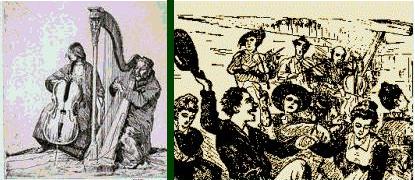
Old World or New, Sacred or Profane
Thursday, April 22, 2010


Classical from before there was "Classical"
Last weekend I was at a dance weekend in a lodge on Mt. Baldy. I had cause to pause and reflect on why in the world am I playing cello, and what am I trying to accomplish, and while I’m at it, what is it I appreciate about music, and admire about musicians, anyway?
Naturally, we had a live band, in this case - Bandáge à Trois, from Utah. I figure, from Friday evening to Sunday evening, they were on for at least 15 hours. When they were on, they played about 85% of the time. The remaining 15% was time when the “caller” (in olden days would be called the Dancing Master) was teaching the dance. While I was not present for all 15 hours, I was for most of it, and I never heard a tune repeated for more than one dance, and many of those tunes were quite distinctive; I would have recognized them. Tunes from all over Europe, in this case, French and Scandinavian tunes were particularly well-represented. Bourrees, branles, waltzes, jigs, reels, polkas, hambos,…. And for each tune within the dance, there was plenty of variation across repeats. A grueling test of endurance. I’m so impressed at their preparation, stamina, teamwork between musicians, teamwork with the caller, excellent tune choices for individual dances, stimulation to the dancers, and musical imagination. I’m still in awe.
That band and caller carries on a special and very challenging tradition that well predates J S Bach. I believe the adjective “classical” is more appropriate to describe what they do, than it is for a present-day so-called classical concert performance of rigidly-defined, fully-papered compositions for immense professional orchestras to silent, motionless audiences. Certainly Louis XIV would have hired this band in a heartbeat.
I wonder how much longer this sort of classical music --- much of it hundred of years old, from many countries, played by a live band, to dancers who actually go through the effort to learn and follow formally-defined steps, with partners, as part of a larger traditional music/dance community --- will survive?
Naturally, we had a live band, in this case - Bandáge à Trois, from Utah. I figure, from Friday evening to Sunday evening, they were on for at least 15 hours. When they were on, they played about 85% of the time. The remaining 15% was time when the “caller” (in olden days would be called the Dancing Master) was teaching the dance. While I was not present for all 15 hours, I was for most of it, and I never heard a tune repeated for more than one dance, and many of those tunes were quite distinctive; I would have recognized them. Tunes from all over Europe, in this case, French and Scandinavian tunes were particularly well-represented. Bourrees, branles, waltzes, jigs, reels, polkas, hambos,…. And for each tune within the dance, there was plenty of variation across repeats. A grueling test of endurance. I’m so impressed at their preparation, stamina, teamwork between musicians, teamwork with the caller, excellent tune choices for individual dances, stimulation to the dancers, and musical imagination. I’m still in awe.
That band and caller carries on a special and very challenging tradition that well predates J S Bach. I believe the adjective “classical” is more appropriate to describe what they do, than it is for a present-day so-called classical concert performance of rigidly-defined, fully-papered compositions for immense professional orchestras to silent, motionless audiences. Certainly Louis XIV would have hired this band in a heartbeat.
I wonder how much longer this sort of classical music --- much of it hundred of years old, from many countries, played by a live band, to dancers who actually go through the effort to learn and follow formally-defined steps, with partners, as part of a larger traditional music/dance community --- will survive?
Wednesday, August 12, 2009
Sunrise from orbit, bending Shakers, racing hawks, sailing hockey pucks...
I read that some of us duffers are having trouble getting motivated to practice. I dunno, on the days I can get to it, which are most, but not as many as I want, it's still the best part of the day.
Back in my cellistic infancy and toddlerhood, I had precious little patience for figurative language describing how to play cello. I wanted to hear concrete specifics and bold assertions; exacting descriptions, ideas that could be tested and evaluated, on the essential mechanics of how the amazing system of interconnected levers we call "a cellist" works. No flowery verbal kaa-kaa. No vague "as-if"s or untestable clap-trap. Like Sergeant Joe Friday, "Just the facts, ma'am!"
That was then, this is now. Ok, I guess I've changed.
I've gone to a place where I can enjoy and appreciate inventive takes-offs that stray far from reality. That is not to say I don't appreciate the "factual" and specific information I gather along the way, it's just that my curiosity in that area seems satisfied. I know there's more I can learn, I know some (but certainly not all) cellists would disagree with me on just about anything (Old-timers here certainly have seen that). Of course, I know there could be substantial observable improvement in my form -- elbow moved up (or down), more bow there, less bow here, hand-shape here, open shoulder there... And I certainly need to fit in quantitatively more practice. But rightly or wrongly, I feel comfortable enough in that area that now I want to not just play "correctly", I want to play imaginatively. And at that, I really am just a cellistic infant.
Some of the figurative, or semi-figurative, language I've heard doesn't work for me, yet. Maybe in the future. So being an incorrigible student, I sometimes make up my own stuff.
Mercifully, I'll skip the racey ones. Some of you may have already read my old sunrise-viewed-from-space imagery. I picture the bow stroke as an immensely wide, gradually-arcing, constantly-moving horizon, and the string as the sun (I'm orbiting upside-down, naturally). When the bow touches the sun's line of sight in just the right spot, and they make just the right amount of contact, not too much, not too little, the radiating sun-string shoots brilliant rays of sound in all directions, piercing the black void, and brightly illuminating the entire bow with sound.
Korny and stupid? Yup.
I got more, even kookier, but I already know those. What 'bout yours? Maybe yours are more imaginative.
Back in my cellistic infancy and toddlerhood, I had precious little patience for figurative language describing how to play cello. I wanted to hear concrete specifics and bold assertions; exacting descriptions, ideas that could be tested and evaluated, on the essential mechanics of how the amazing system of interconnected levers we call "a cellist" works. No flowery verbal kaa-kaa. No vague "as-if"s or untestable clap-trap. Like Sergeant Joe Friday, "Just the facts, ma'am!"
That was then, this is now. Ok, I guess I've changed.
I've gone to a place where I can enjoy and appreciate inventive takes-offs that stray far from reality. That is not to say I don't appreciate the "factual" and specific information I gather along the way, it's just that my curiosity in that area seems satisfied. I know there's more I can learn, I know some (but certainly not all) cellists would disagree with me on just about anything (Old-timers here certainly have seen that). Of course, I know there could be substantial observable improvement in my form -- elbow moved up (or down), more bow there, less bow here, hand-shape here, open shoulder there... And I certainly need to fit in quantitatively more practice. But rightly or wrongly, I feel comfortable enough in that area that now I want to not just play "correctly", I want to play imaginatively. And at that, I really am just a cellistic infant.
Some of the figurative, or semi-figurative, language I've heard doesn't work for me, yet. Maybe in the future. So being an incorrigible student, I sometimes make up my own stuff.
Mercifully, I'll skip the racey ones. Some of you may have already read my old sunrise-viewed-from-space imagery. I picture the bow stroke as an immensely wide, gradually-arcing, constantly-moving horizon, and the string as the sun (I'm orbiting upside-down, naturally). When the bow touches the sun's line of sight in just the right spot, and they make just the right amount of contact, not too much, not too little, the radiating sun-string shoots brilliant rays of sound in all directions, piercing the black void, and brightly illuminating the entire bow with sound.
Korny and stupid? Yup.
I got more, even kookier, but I already know those. What 'bout yours? Maybe yours are more imaginative.
Wednesday, February 11, 2009
Anyone doing T'ai Chi + Cello?
Last night was my fourth T'ai Chi class, more specifically, T'ai Chi Chih. Over two years ago I decided to look into it based on things said by Vic Sazer.
The classes are 45 minutes of soft motions, led by an 80-some year-old instructor. For the second time now, starting at about the 25 minute point or so, my arms start to get that feeling of lightness and effortless-ness that I've only rarely managed to feel behind a cello. Like my arms have lost some weight and the joints have had a squirt of graphite applied. I know at least a handful of you know what I mean.
One thing that concerns me is that "T'ai Chi Chih" is a registered trademark. Apparently it was "invented" by Justin F. Stone in the 70's. Hmmm.
As if I don't have way too much to do as it is, I hope to pursue this T'ai Chi thing some more, doing it immediately before some cello practices, IF I can keep my motivation and patience up for it. Has anybody tried it?
The classes are 45 minutes of soft motions, led by an 80-some year-old instructor. For the second time now, starting at about the 25 minute point or so, my arms start to get that feeling of lightness and effortless-ness that I've only rarely managed to feel behind a cello. Like my arms have lost some weight and the joints have had a squirt of graphite applied. I know at least a handful of you know what I mean.
One thing that concerns me is that "T'ai Chi Chih" is a registered trademark. Apparently it was "invented" by Justin F. Stone in the 70's. Hmmm.
As if I don't have way too much to do as it is, I hope to pursue this T'ai Chi thing some more, doing it immediately before some cello practices, IF I can keep my motivation and patience up for it. Has anybody tried it?
Tuesday, January 27, 2009
CTMS New Year's Camp
Back about 4 weeks ago now, my wife and I again attended the CTMS New Year's Camp out at Camp Hess Kramer. I'm pleased to report that we won 2nd place in the New Years Eve Costume Parade (Rod Blagoyevich and Senator Wannabe), although I feel "Barbie at 60", who placed 3rd, should've won. She was hysterical. We didn't recognize the next day without her wig, heels, knock-knees, "implants", and other paraphernalia.
Thank you to the management of Hess Kramer, who make the facility to many different groups.
No cello classes, but still plenty to do, even for the non-musician, such as dancing, walks to the beach, a class in stretching (which I thought was particularly informative), a puzzle table, and a craft table. Also, various classes in guitar, playing for dances, shape note singing, etc. Also jams and song circles.
Carl, one of the campers, has posted pictures at
http://flickr.com/photos/cbernhardt/sets/72157612889085932/. Look though them and you'll find three pictures of a middle-aged cello duffer playing with others. Proof that I do get out on rare occasion.
Thank you to the management of Hess Kramer, who make the facility to many different groups.
No cello classes, but still plenty to do, even for the non-musician, such as dancing, walks to the beach, a class in stretching (which I thought was particularly informative), a puzzle table, and a craft table. Also, various classes in guitar, playing for dances, shape note singing, etc. Also jams and song circles.
Carl, one of the campers, has posted pictures at
http://flickr.com/photos/cbernhardt/sets/72157612889085932/. Look though them and you'll find three pictures of a middle-aged cello duffer playing with others. Proof that I do get out on rare occasion.
Sunday, January 18, 2009
Inspiring folk cello sighting
Last night I attended a concert with Hans York as the opening act, accompanied by Myra Joy on cello. Myra Joy's a grad of San Francisco Conservatory (Must be a very very recent grad -- Are those kids getting younger or am I just getting really really ancient? You don't have to answer that in writing here) and has been playing with a number of groups. She related to me about how she got started: she just attended a local jam and was spotted by Shay and Micheal Black, and suddenly approached and asked to go on tour with them.
Ms. Joy's playing for Hans York is understated, matching his voice and style quite well, I thought. For a video that shows her typical playing in song, see Listen to the Moon which was recorded in Fresno last May.
I'm adding her to my list of cellists to watch.
Ms. Joy's playing for Hans York is understated, matching his voice and style quite well, I thought. For a video that shows her typical playing in song, see Listen to the Moon which was recorded in Fresno last May.
I'm adding her to my list of cellists to watch.
Monday, December 29, 2008
Cellistic New Year Resolutions
One thing I find fascinating about learning cello, and did not at all expect, is the paradoxes. Now that I've met some of them, my hope for 2009 is that I allow myself to appreciate and revel in them.
Ok, for you they might not make sense. You know far better than me what is right for you. But as these years go fleetingly by, they are becoming for me the elusive essence behind learning and practicing the cello. Otherwise, at my age, lack of talent, and station in life, why bother? So here's my list (partly inspired by, but not to be blamed on, writings in Stark Raving Cello):
- To stop trying harder; instead, to just try easier.
- To play fast slowly; to play loud gently; to play slow fleetingly; to play soft intensely; to play easy things with attentive, loving care; to play hard things undeservedly carefree.
- Instead of frustration, to allow myself unwarranted pleasure and joy in visiting and re-visiting my weak areas, with unworried faith that it'll come together, whenever I eventually allow it.
- To hear musical forests, instead of trees of notes.
- To feel more, listen more, absorb more, hear more, sing more, dream more, express more, enjoy more. Worry, doubt, fear, control, and struggle (and ok, write!) less.
Ok, for you they might not make sense. You know far better than me what is right for you. But as these years go fleetingly by, they are becoming for me the elusive essence behind learning and practicing the cello. Otherwise, at my age, lack of talent, and station in life, why bother? So here's my list (partly inspired by, but not to be blamed on, writings in Stark Raving Cello):
- To stop trying harder; instead, to just try easier.
- To play fast slowly; to play loud gently; to play slow fleetingly; to play soft intensely; to play easy things with attentive, loving care; to play hard things undeservedly carefree.
- Instead of frustration, to allow myself unwarranted pleasure and joy in visiting and re-visiting my weak areas, with unworried faith that it'll come together, whenever I eventually allow it.
- To hear musical forests, instead of trees of notes.
- To feel more, listen more, absorb more, hear more, sing more, dream more, express more, enjoy more. Worry, doubt, fear, control, and struggle (and ok, write!) less.
Subscribe to:
Posts (Atom)