Maynard’s mentioned James Oswald. In case you’ve never heard of that famed cellist, let me you about him, by way of Benjamin Franklin.
Since I was seven years-old I’ve admired and wanted to be like ol’ Ben (Hey, I’m from Philly, what would you expect --- all the sports teams were in the cellar through the entire 60’s.)
Now, for much of his life, Ben Franklin was a Londoner wannabe. He was enthralled with all things English, and with London, his perceived center of the cultural Universe. In 1757, after becoming a wildly successful businessman; postmaster; inventor; brilliant scientist; highly acclaimed author and publisher; founder of fire and insurance companies, libraries and numerous organizations for the public good; lead perhaps the first environmental protest ever; recipient of at least three honorary doctorates, and only the most famous American, by far, the world over, Dr. Franklin traveled to London to represent his home, the ever loyal American colonies. He was considering staying in London permanently.
London was not impressed with this uppity commoner, but then soon, neither was Franklin with London, who saw the aristocratic system there as hopelessly corrupt. By 1774, he would be publicly condemned and humiliated before London's Privy Council. The next day he fled England convinced that the colonies must become an independent nation, and the rest, as they say, is history.
But back to music. Franklin was fortunate enough, by our standards, to have heard G.F. Handel’s last concert. He didn’t care for it. Too much repetition. He felt it was indicative of a lack of intelligence.
But he was very impressed indeed with a different court composer – James Oswald. Oswald was an import to the court from Scotland. In addition to composing, Oswald played cello, and collected and published folk tunes of his homeland (They are still available, I have his book “A Curious Collection of Scots Tunes” in PDF format). In a letter to Lord Kames, Franklin remarked that when a musician named James Oswald played tunes on his cello, the crowds fell in love with it so much that he witnessed "tears of pleasure in the eyes of his auditors".
But don’t just believe me, go to http://www.whyy.org/artsandculture/stories.html , do a Find on Franklin, and listen to two of Franklin’s favorite Oswald tunes, one of which is performed beautifully on solo viola da gamba.
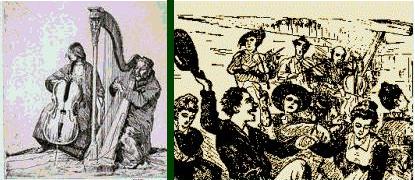
Old World or New, Sacred or Profane
Tuesday, January 30, 2007


Saturday, January 27, 2007
The Kitchen Musicians
For, I guess, nearing 20 years now, Sara and Maynard Johnson have published books and recordings, and performed at re-enactments and historically themed events. They perform and publish music of the Renaissance through to the American Civil War. They also publish articles on the music and customs of those periods.
Sara plays various hammer dulcimers, harpischord, spinet, piano, cittern, and pocket fiddle (also called a kit or pochette). Maynard plays recorders and flageolets (aka whistles) of various types, cittern, and English guitar. Together with a variety of others, depending upon the venue, they make up the group Rogue's Consort.
Their web site, www.kitchenmusician.net, has long been a source for others who play that kind of music, especially for the hammer dulcimer community.
A few weeks ago I was alerted, through a hammer dulcimer friend, who learned about it through a hammer dulcimer web list, that the Kitchen Musician site has a new CD, Oceans So Green, with cello on it.
Well, this was something new. None of their other recordings had cello, but sure enough, Maynard played cello on this new CD. The music they perform is what we do, so to keep abreast of the field, I ordered that CD along with their previous one, Pass'd Times. I've heard them now, and: Well done, Maynard! While I wasn't around back then, it seems to me this CD shows very well what role cello would play in this genre during that period.
About half the tracks of Oceans So Green have cello to one degree or another; on some it's hardly noticeable. Two of the tracks, Carolan's Receipt and The Night Before Larry Was Stretched, have very prominent pizzicato cello melody. Their website contains a sample of The Night Before Larry Was Stretched.
Now, Maynard is clearly not a conservatory-trained cellist practicing the great classical concertos 6 hours a day. He's a relative beginner playing in a physical manner that departs from modern orthodox cello technique. But then, the real people that played this music those centuries ago had hard lives with hard labor day jobs, limited education opportunities, and very limited spare time. That's the true HIPP!
I've been in contact with Maynard, and I'd like to conclude with his own words:
Sara plays various hammer dulcimers, harpischord, spinet, piano, cittern, and pocket fiddle (also called a kit or pochette). Maynard plays recorders and flageolets (aka whistles) of various types, cittern, and English guitar. Together with a variety of others, depending upon the venue, they make up the group Rogue's Consort.
Their web site, www.kitchenmusician.net, has long been a source for others who play that kind of music, especially for the hammer dulcimer community.
A few weeks ago I was alerted, through a hammer dulcimer friend, who learned about it through a hammer dulcimer web list, that the Kitchen Musician site has a new CD, Oceans So Green, with cello on it.
Well, this was something new. None of their other recordings had cello, but sure enough, Maynard played cello on this new CD. The music they perform is what we do, so to keep abreast of the field, I ordered that CD along with their previous one, Pass'd Times. I've heard them now, and: Well done, Maynard! While I wasn't around back then, it seems to me this CD shows very well what role cello would play in this genre during that period.
About half the tracks of Oceans So Green have cello to one degree or another; on some it's hardly noticeable. Two of the tracks, Carolan's Receipt and The Night Before Larry Was Stretched, have very prominent pizzicato cello melody. Their website contains a sample of The Night Before Larry Was Stretched.
Now, Maynard is clearly not a conservatory-trained cellist practicing the great classical concertos 6 hours a day. He's a relative beginner playing in a physical manner that departs from modern orthodox cello technique. But then, the real people that played this music those centuries ago had hard lives with hard labor day jobs, limited education opportunities, and very limited spare time. That's the true HIPP!
I've been in contact with Maynard, and I'd like to conclude with his own words:
"I started playing cello before we recorded the Pass'd Times Album, just didn't use it on the album.
"We have been going to the Jink & Diddle School of Scottish Fiddling for 15 years or so. Since I don't play fiddle, I had tried playing accompaniment on guitar or ten string cittern, but wasn't happy with that. A lot of the music published by 18th century fiddlers includes a bass line, often described as for violincello, harpschord or pianoforte. The great 18th century Scottish Fiddler, Niel Gow, often played with his brother Donald accompanying him on cello. There's a painting of them which also appears on Highland Games T-shirts. Donald is the one playing cello in a kilt, with baroque grip (no end pin) and underhand viol grip on the bow.
"I've also seen other pictures of 18th century cellist playing in the same position. It's not surprising, since the bass viola da gamba is about dead on the size of a cello, and had no end pin. Neither did the cello until maybe about 1800. Some of the old descriptions refer to the cello as the "bass". In an age when your primary method of transport was your feet, a cello is about as big as anyone could handle.
"Since we perform in a variety of historic settings for that time period, I wanted to stick with the period style as much as possible. We often perform as a trio, with Sara on hammered dulcimer, Michael Thompson (or John, or Carmen) on fiddle, and me on cello. Paul Gifford's book on the history of the hammered dulcimer says that a typical performance ensemble for dulcimer in the 1700s was dulcimer, fiddle and cello.
"As a practical matter, when the cello is in a viol or baroque position, underhand bow grip makes a lot of sense. With a baroque grip, the strings are almost straight up and down, and with a modern overhand bow grip, gravity is NOT your friend; the bow wants to slide down to the floor. A practical advantage of my archaic playing style is that I take up a lot less floor space than a cellist with an end pin. When you are playing for gambols in Colonial Williamsburg's Chowning's Tavern, having a small footprint is essential. An end pin would be a safety hazard.
"Some of my backup style comes from instinct, and years of playing and teaching backup guitar for dances and instrumental folk music in the 80s and 90s. And some of it comes from the bass lines written in the music from the 1700s. On the Oceans so Green CD, on those tunes identified as Bunting's arrangement, the cello backup is from Bunting's bass line. On So Merrily Dance the Quaker, the cello line comes from Henry Beck's copybook. Both Bunting and Beck has some bass line ideas that I had not thought of on my own.
"One of the things I love about cello in this setting is that it is much lower in pitch than typical folk backup instruments, such as guitar. It thus almost never doubles with or overlaps the melody notes of the dulcimer or fiddle, and it gives the combined performance a much fuller tonal range. And unlike a guitar, the cello can do pizzacato bassline, detache bowed notes, or long bow slurred notes, or a bowed ground, which makes it more flexible.
"Sometimes I do have to remind myself that I am not the lead instrument. "Remember, you're not Pablo Casals or Yo-Yo Ma; or even James Oswald; you're Donald Gow and you are playing bass accompaniment." And when, like Donald Gow, I play wearing a kilt, I have to remind myself about how to sit down and how to stand up and where the cello should be at which times.
"My cello is a late 19th century Mittenwald instrument, and has pretty good projection and tone, so I can play bass under or behind several fiddles and still hear myself and be heard. My bow is a snakewood bass gamba bow from Shar. My case is a beat up and sprung fiberglass monster that is waiting for Shar to have another sale on cello cases.
I've been hoping that some junior high and high school history teachers will find out about the album and use it as we approach St. Patrick's Day."
Wednesday, January 24, 2007
A Road to Cello - Chapter 4
Lesseee, I left off in the fall of 2002 playing my home-made fixed-neck washtub bass. It was interesting and different, but it wasn't completely satisfying. I still intended to start anew on a real instrument; I just hadn't decided what. Fiddle had some appeal, but it seemed so difficult; everything goes so fast and fiddle is so hard at first. I had heard beginning fiddlers, ummm, well, it's obviously a long learning curve. None of the other commonly heard instruments were calling out to me yet.
At the time my fiance was interested in starting hammer dulcimer. That instrument had long had a special appeal to her. So one day I went down to a local folkie instrument shop to look at hammer dulcimers for her. I didn't buy one then, but a CD caught my eye, "Simple Gifts" by a group of musicians in Santa Cruz, containing a collection of Shaker tunes. I recognized many of the names of the players from my fiance's old, worn, tapes that we played on long car trips. At the time I vaguely knew the Shakers had left behind a large body of tunes which intrigued Aaron Copland; Simple Gifts was merely the best known because he included it in both Appalachian Spring and his Old American Songs. The CD had hammer dulcimer in it, along with Appalachian dulcimer, flute, alto flute, English horn, violin, viola, mandolin, harp, bowed psaltery, spoons, cello, steel-string and classical guitar, and I forget what else. The arrangements were written by the guitar player, William Coulter, and the cellist, Barry Phillips. I thought maybe she would really like this, and we certainly could use a CD of the Santa Cruz gang instead of those old cassette tapes from the 80's.
When we played it, I was more than impressed. What a superb tribute to those social pioneers! In tune, cleanly played, expertly and imaginatively arranged, with respect and enthusiasm for the values of a humble, devout, plain-living frontier people (when Ohio and Indiana and Kentucky was the frontier) who lived and worshipped by the beat of their own original heaven-sent songs and dances.
Coulter and Phillips had both earned MMs at the San Francisco Conservatory of Music, Coulter's degree is in guitar performance, Phillips' is in composition.
Then there was the cello. Of the CD's 20 tunes on 11 tracks, the cello has the melody on only four of the simple diatonic tunes, usually for only a short time. Elsewhere it plays modest accompaniment, or not at all. All of it sounded so easy, as if no effort or technical difficulty was involved at all -- as easy as singing in the shower, yet, I couldn't take my ears off of it.
(At the time it wouldn't have meant anything to me, but Phillips had been a cello student of Irene Sharp at San Francisco, who in turn was a student of Margaret Rowell.)
And the cello, as played by Phillips, provided something something I had not heard much in folkie music: Inversions! Everything wasn't all 1-5-1-5... ad tedium. The bass lines, pizz or arco, were melodic, adding depth to the already existing height and width of the tunes. It brought class to folk.
One place the cello does play melody is in the Shaker version of the Lord's Prayer (Our Savior's Universal Prayer). It's slow; the notes go only from G at the bottom of bass clef to A at the top of bass clef. Yet, for me it was one of the best parts of the CD. It so evokes an image of an old God-fearing man singing the sacred words in an original ad hoc melody rising directly from his heart.
Too bad I didn't know any cellists; a cello is an arranger's dream, I thought. And for me to start cello was out of the question. Too old... I don't know where to start... I don't know who could teach me... Too out of the mainstream for the musicians I know... Way too expensive... Even more way too time consuming... Ah, but if only I had life to do over again...
A little research revealed that cello tuning would make most of tunes played in the groups and jams I knew very difficult, if not impractical. A lot of shifting at very high speed. It just didn't seem workable.
That CD is still available, or you can hear some samples, each of which has cello in the accompaniment, at Simple Gifts. One can also download it from iTunes. No, I don't get a cut ;-)
At the time my fiance was interested in starting hammer dulcimer. That instrument had long had a special appeal to her. So one day I went down to a local folkie instrument shop to look at hammer dulcimers for her. I didn't buy one then, but a CD caught my eye, "Simple Gifts" by a group of musicians in Santa Cruz, containing a collection of Shaker tunes. I recognized many of the names of the players from my fiance's old, worn, tapes that we played on long car trips. At the time I vaguely knew the Shakers had left behind a large body of tunes which intrigued Aaron Copland; Simple Gifts was merely the best known because he included it in both Appalachian Spring and his Old American Songs. The CD had hammer dulcimer in it, along with Appalachian dulcimer, flute, alto flute, English horn, violin, viola, mandolin, harp, bowed psaltery, spoons, cello, steel-string and classical guitar, and I forget what else. The arrangements were written by the guitar player, William Coulter, and the cellist, Barry Phillips. I thought maybe she would really like this, and we certainly could use a CD of the Santa Cruz gang instead of those old cassette tapes from the 80's.
When we played it, I was more than impressed. What a superb tribute to those social pioneers! In tune, cleanly played, expertly and imaginatively arranged, with respect and enthusiasm for the values of a humble, devout, plain-living frontier people (when Ohio and Indiana and Kentucky was the frontier) who lived and worshipped by the beat of their own original heaven-sent songs and dances.
Coulter and Phillips had both earned MMs at the San Francisco Conservatory of Music, Coulter's degree is in guitar performance, Phillips' is in composition.
Then there was the cello. Of the CD's 20 tunes on 11 tracks, the cello has the melody on only four of the simple diatonic tunes, usually for only a short time. Elsewhere it plays modest accompaniment, or not at all. All of it sounded so easy, as if no effort or technical difficulty was involved at all -- as easy as singing in the shower, yet, I couldn't take my ears off of it.
(At the time it wouldn't have meant anything to me, but Phillips had been a cello student of Irene Sharp at San Francisco, who in turn was a student of Margaret Rowell.)
And the cello, as played by Phillips, provided something something I had not heard much in folkie music: Inversions! Everything wasn't all 1-5-1-5... ad tedium. The bass lines, pizz or arco, were melodic, adding depth to the already existing height and width of the tunes. It brought class to folk.
One place the cello does play melody is in the Shaker version of the Lord's Prayer (Our Savior's Universal Prayer). It's slow; the notes go only from G at the bottom of bass clef to A at the top of bass clef. Yet, for me it was one of the best parts of the CD. It so evokes an image of an old God-fearing man singing the sacred words in an original ad hoc melody rising directly from his heart.
Too bad I didn't know any cellists; a cello is an arranger's dream, I thought. And for me to start cello was out of the question. Too old... I don't know where to start... I don't know who could teach me... Too out of the mainstream for the musicians I know... Way too expensive... Even more way too time consuming... Ah, but if only I had life to do over again...
A little research revealed that cello tuning would make most of tunes played in the groups and jams I knew very difficult, if not impractical. A lot of shifting at very high speed. It just didn't seem workable.
That CD is still available, or you can hear some samples, each of which has cello in the accompaniment, at Simple Gifts. One can also download it from iTunes. No, I don't get a cut ;-)
Thursday, January 18, 2007
Let's Have Jam for Breakfast

Those who read Cello Chat might understand why I call this "Wrong Seating #74."
This is from New Year's Camp, taken by the dulcimer player's husband. It looks like one of the breakfast jams in the dining hall. Ok, LA Chamber Orchestra we ain't, but we's is havin' fun anyways. Why am I sitting up front? I much prefer my usual place, way in the back.
Monday, January 15, 2007
Teamwork: the 4th Element?
In a very basic music theory or appreciation class, one learns that the essential elements of music are rhythm, melody, and harmony. Rhythm evokes tension and release in the mind of the listener by a series of tones that come to rest on an agogic accent. Melody evokes tension and release by combining the rhythm with a curve of successive prominent pitches that come to a rest at the end of a phrases. Harmony evokes tension and release by the perceived instability and stability of simultaneous, or near simultaneous, tones.
And that's enough to call it music. No more is strictly necessary.
But I suggest there is another element that many of us crave from music. I think of it as teamwork. It's not all that different from the sort of teamwork one sees on the sports field. The changes of musical focus: anticipation, cooperation, resolution; produce an ebb and flow not unlike the tension and release produced by the other elements.
In the Banshee in the Kitchen! workshop one could hear how ebb and flow affect their decision making. Three players - three inter-player relationships. Each player's decision on what to play cannot be made in a vacuum, the relationships to the other two players must be considered.
They might not like me saying so, but their workshop reminded me of the 30-some year old P.D.Q. Bach "New Horizons in Music Apprciation" skit. It's a "concert-cast" of the 1st movement of Beethoven's 5th symphony. If you've never heard it, you just must go order it now! Peter Shickele and Robert Dennis provide a play-by-play running commentary on the composition and performance as if it were a ball game. Absolutely hysterical!
As farcical as it is, it speaks truth. There is a game going on there on the stage. The "ball," i.e. musical focus, moves from section to section, with tension and release between players and sections as they follow the game plan. And when it all works, it is a joy to behold.
It's been quite a few years since I've heard it, but some lines still stand out in my memory. Below I attempt to recall and paraphrase some excerpts that remain lodged in my mind:
Orchestra: Ta-ta-ta-taaaaa... Do-do-do-doooo...
Shickle: "And they're OFF on a four-note theme!
Orchestra continues....
Shickle: "Oh, it's very exciting. The start of a symphony is always very exciting, but I don't know if it's slow or fast yet because it keeps stopping!"
. . .
French horn warbles on entrance...
Shickele: "Wow, Bob, did you hear that! That horn player really fumbled that note. I think that was number 61, wasn't it, Bob?"
Dennis: "Yes, Pete, that was Bobbie Corno and that's his 4th major flub of the season, which gives him a solo average of .8753 which is pretty darn low for a 1st chair player, but he's popular with the fans and he's really strong in the long concertos, so maybe they'll keep him around for another season, on the other hand..."
. . .
Shickele: "That sound like a recap. Is it time for a recap, Bob?"
Dennis: "Well, yes, Pete, the average symphony has a recap just after the 1st quarter and this one's falling right into line."
. . .
Shickele: "The strings are cutting up that theme into little pieces. It's getting downright lethargic down there, if you want to know the truth.... [Brass entrance] The brasses have tried to wake them up, a welcome relief, but to no avail."
. . .
Shickele: "Nobody but nobody knows where the theme is down there. Why, the players are as lost as we are. Wait a minute! Wait a minute!!! The brasses have got a hold of that theme! The brasses have got a hold of that theme and THEY ARE NOT GOING TO LET GO!!!"
. . .
Shickele: "... and it's tutti all way and it looks like they have a great symphony on their hands. But wait, I can't believe my ears, it sounds like another recap! If that happens that will be the first time in 15 years of concert casting.
Dennis: "Well, I think that's something the Composer's Commission will have to look into.
Shickele: "Right you are, Bob. Wait a minute, those are final chords, though. Is it? Wait! The referee is lowering his hands. YES!!! That is the end of the piece! The players are now taking off their helmets and acknowledging the cheers of the crowd!"
And that's enough to call it music. No more is strictly necessary.
But I suggest there is another element that many of us crave from music. I think of it as teamwork. It's not all that different from the sort of teamwork one sees on the sports field. The changes of musical focus: anticipation, cooperation, resolution; produce an ebb and flow not unlike the tension and release produced by the other elements.
In the Banshee in the Kitchen! workshop one could hear how ebb and flow affect their decision making. Three players - three inter-player relationships. Each player's decision on what to play cannot be made in a vacuum, the relationships to the other two players must be considered.
They might not like me saying so, but their workshop reminded me of the 30-some year old P.D.Q. Bach "New Horizons in Music Apprciation" skit. It's a "concert-cast" of the 1st movement of Beethoven's 5th symphony. If you've never heard it, you just must go order it now! Peter Shickele and Robert Dennis provide a play-by-play running commentary on the composition and performance as if it were a ball game. Absolutely hysterical!
As farcical as it is, it speaks truth. There is a game going on there on the stage. The "ball," i.e. musical focus, moves from section to section, with tension and release between players and sections as they follow the game plan. And when it all works, it is a joy to behold.
It's been quite a few years since I've heard it, but some lines still stand out in my memory. Below I attempt to recall and paraphrase some excerpts that remain lodged in my mind:
Orchestra: Ta-ta-ta-taaaaa... Do-do-do-doooo...
Shickle: "And they're OFF on a four-note theme!
Orchestra continues....
Shickle: "Oh, it's very exciting. The start of a symphony is always very exciting, but I don't know if it's slow or fast yet because it keeps stopping!"
. . .
French horn warbles on entrance...
Shickele: "Wow, Bob, did you hear that! That horn player really fumbled that note. I think that was number 61, wasn't it, Bob?"
Dennis: "Yes, Pete, that was Bobbie Corno and that's his 4th major flub of the season, which gives him a solo average of .8753 which is pretty darn low for a 1st chair player, but he's popular with the fans and he's really strong in the long concertos, so maybe they'll keep him around for another season, on the other hand..."
. . .
Shickele: "That sound like a recap. Is it time for a recap, Bob?"
Dennis: "Well, yes, Pete, the average symphony has a recap just after the 1st quarter and this one's falling right into line."
. . .
Shickele: "The strings are cutting up that theme into little pieces. It's getting downright lethargic down there, if you want to know the truth.... [Brass entrance] The brasses have tried to wake them up, a welcome relief, but to no avail."
. . .
Shickele: "Nobody but nobody knows where the theme is down there. Why, the players are as lost as we are. Wait a minute! Wait a minute!!! The brasses have got a hold of that theme! The brasses have got a hold of that theme and THEY ARE NOT GOING TO LET GO!!!"
. . .
Shickele: "... and it's tutti all way and it looks like they have a great symphony on their hands. But wait, I can't believe my ears, it sounds like another recap! If that happens that will be the first time in 15 years of concert casting.
Dennis: "Well, I think that's something the Composer's Commission will have to look into.
Shickele: "Right you are, Bob. Wait a minute, those are final chords, though. Is it? Wait! The referee is lowering his hands. YES!!! That is the end of the piece! The players are now taking off their helmets and acknowledging the cheers of the crowd!"
Sunday, January 14, 2007
Teacher Asks
My cello teacher is asking her adult students:
As she accumulates more adult students, she's wants to consider the issues for adults more closely.
I've placed this question on CBN, too, but perhaps I'll get different, maybe more candid, responses here.
What particular things were you taught in the beginning that you feel were most helpful? What things do you wish you were taught earlier?
As she accumulates more adult students, she's wants to consider the issues for adults more closely.
I've placed this question on CBN, too, but perhaps I'll get different, maybe more candid, responses here.
Tuesday, January 09, 2007
Arrangements of Traditional Music: Good, Bad or Ugly?
Many of the the tunes I accompany or play were composed by a lone singer, fiddler, harpist, or other instrumentalist and performed without harmonic accompaniment since centuries ago. Without that tradition, maintained by poor folk with bare subsistence day jobs, we wouldn't have that body of music.
Is it wrong to accompany them with a line or chord sequence that was not a part of that melody's original single-line tradition?
Is it wrong to combine different tunes into medleys? Different tunes from different countries or eras?
What of using classical Common Practice Era conventions to compose original introductions, bridges, modulations, vamps, inversions in bass lines, counter-melodies, and parallel harmonies?
What of applying modern jazz/rock/pop-derived chords, rhythms, riffs, and "grooves"?
Electronic effects? Synthesizers? Looping machines? Is it all OK? Is the David Downes' highly-produced PBS "Celtic Woman" extravaganza of "She Moved Through the Fair" with synthesizers, back-up chorus, 60-piece orchestra, and smoke machines still a traditional folk song as it stands alongside "Somewhere" from West Side Story and "Someday" from the Disney animated Hunchback of Notre Dame? At what point does the healthily functioning gag reflex prompt a frantic self-protective lunge for the remote control?
At New Year's Camp I watched a workshop on Celtic guitar (sadly, I don't play guitar) by Mary of Banshee in the Kitchen! followed by a workshop by all the members of Banshee in the Kitchen! on how they come up with their arrangements. My hope was to get inspiration for bringing some ideas into the music I play with the little local group. Brenda acknowledged right off that some folks are not comfortable with arrangements; some even disapprove of accompaniment, yet alone arrangements.
Indeed, I have heard one person express the feeling that Banshee in the Kitchen! over -arranges. I don't agree, my background and evolved taste appreciates imaginative, colored, sometimes surprising, sometimes subtle variations in both melody and accompaniment. But a part of me does understand reverence for the centuries-old minimalist tradition. Long may it also continue.
Is it wrong to accompany them with a line or chord sequence that was not a part of that melody's original single-line tradition?
Is it wrong to combine different tunes into medleys? Different tunes from different countries or eras?
What of using classical Common Practice Era conventions to compose original introductions, bridges, modulations, vamps, inversions in bass lines, counter-melodies, and parallel harmonies?
What of applying modern jazz/rock/pop-derived chords, rhythms, riffs, and "grooves"?
Electronic effects? Synthesizers? Looping machines? Is it all OK? Is the David Downes' highly-produced PBS "Celtic Woman" extravaganza of "She Moved Through the Fair" with synthesizers, back-up chorus, 60-piece orchestra, and smoke machines still a traditional folk song as it stands alongside "Somewhere" from West Side Story and "Someday" from the Disney animated Hunchback of Notre Dame? At what point does the healthily functioning gag reflex prompt a frantic self-protective lunge for the remote control?
At New Year's Camp I watched a workshop on Celtic guitar (sadly, I don't play guitar) by Mary of Banshee in the Kitchen! followed by a workshop by all the members of Banshee in the Kitchen! on how they come up with their arrangements. My hope was to get inspiration for bringing some ideas into the music I play with the little local group. Brenda acknowledged right off that some folks are not comfortable with arrangements; some even disapprove of accompaniment, yet alone arrangements.
Indeed, I have heard one person express the feeling that Banshee in the Kitchen! over -arranges. I don't agree, my background and evolved taste appreciates imaginative, colored, sometimes surprising, sometimes subtle variations in both melody and accompaniment. But a part of me does understand reverence for the centuries-old minimalist tradition. Long may it also continue.
Subscribe to:
Posts (Atom)